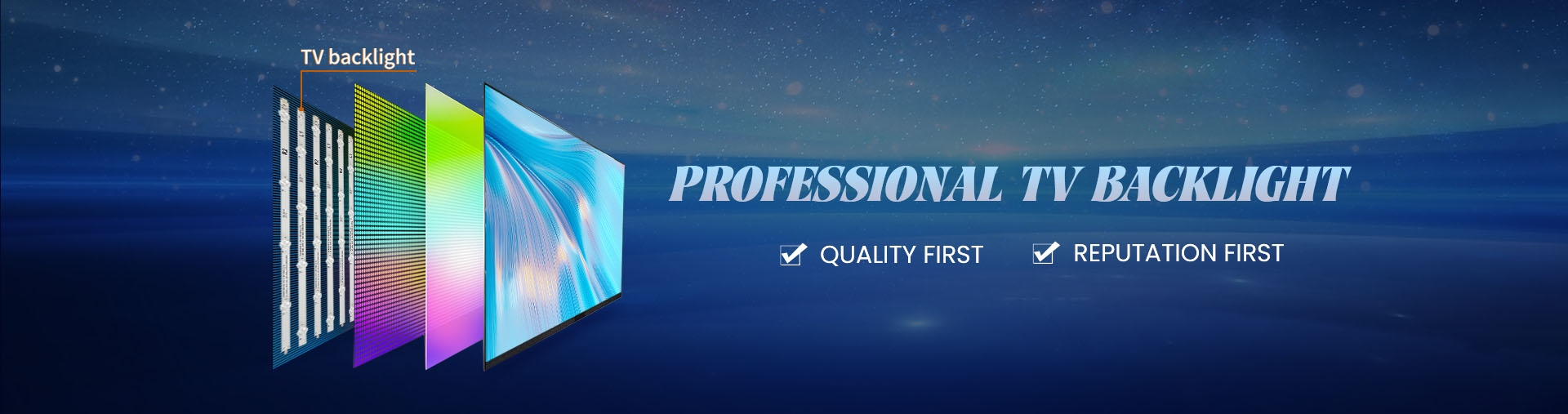
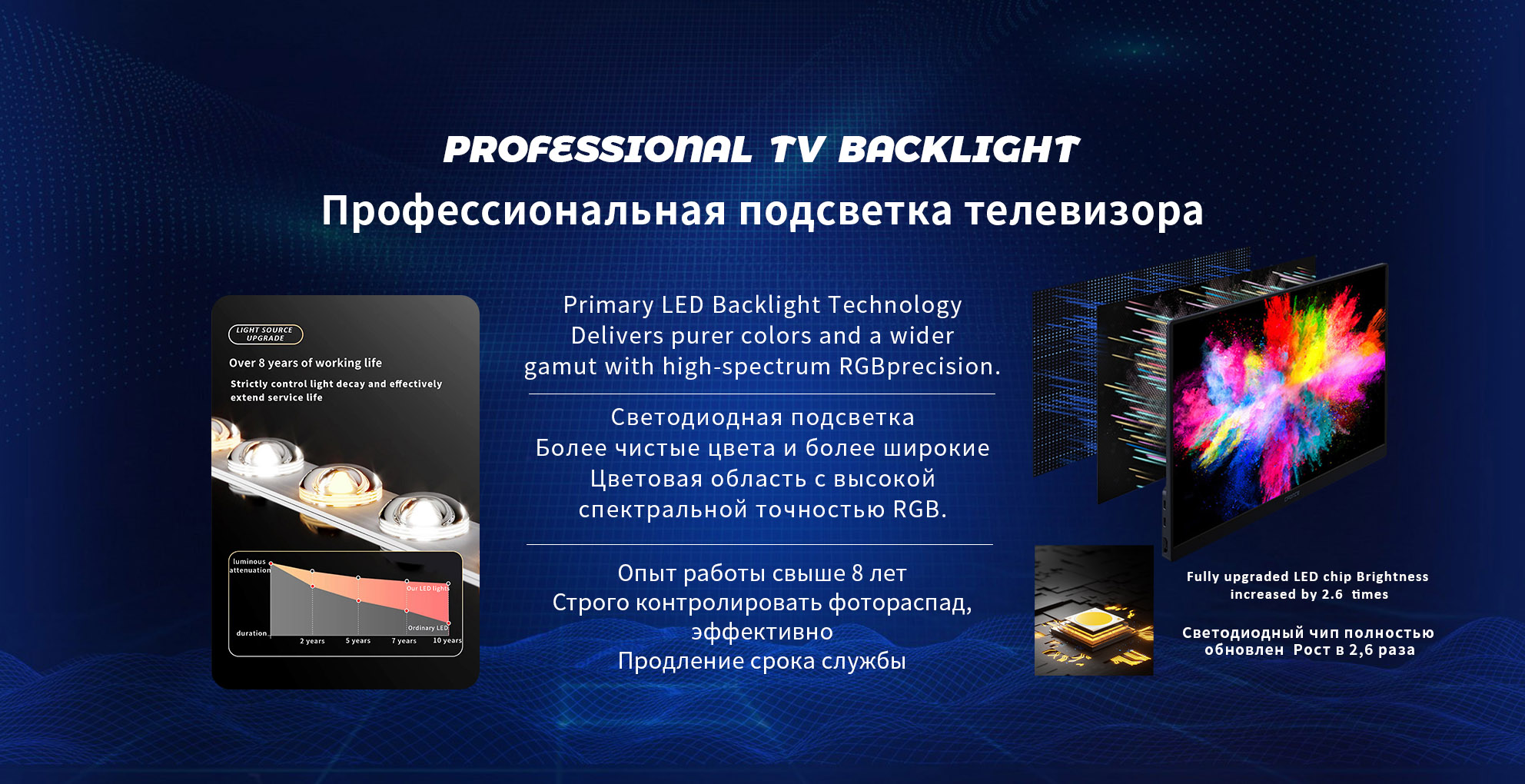
Led Backlight Strips are a core component of modern LCD TVs, directly influencing brightness, contrast, uniformity, thermal behavior, and long-term reliability. Among current TV designs, Direct (Direct-Lit / Full-Array) and Edge backlight strips represent two fundamentally different technical routes.
From a manufacturing and system-integration perspective, understanding their differences helps align product positioning, cost control, optical targets, and reliability expectations.
1) Structural Layout and Light Path
Edge backlight strips are installed along one or more edges of the LCD panel. Light emitted from the strips enters a light guide plate, which spreads illumination across the entire screen surface before passing through diffuser and prism films.
This architecture relies heavily on optical materials to distribute light evenly, making optical design and assembly precision critical to final display quality.
Direct Backlight Strips
Direct backlight strips are mounted behind the LCD panel, arranged in rows or grids. Light travels forward directly through diffuser layers without relying on a light guide plate for lateral distribution.
Because illumination originates across the full panel area, brightness uniformity is primarily controlled by strip layout, LED spacing, and diffusion films rather than edge-based light injection.
2) Brightness and Uniformity Performance
Edge backlight systems typically achieve moderate brightness levels and are optimized for everyday viewing scenarios. However, uniformity can be more sensitive to:
Direct backlight systems offer higher peak brightness and more stable luminance distribution. With LEDs positioned across the entire back surface, it is easier to maintain consistent brightness in large screen sizes and high-luminance designs.
3) Local Dimming Capability
Local dimming directly affects contrast and dark-scene performance.
Edge backlight strips usually support limited local dimming, often implemented in vertical or horizontal zones. The number of dimming zones is constrained by strip placement and light guide behavior.
Direct backlight strips can support multi-zone local dimming more effectively. Each section of the backlight can be controlled independently, improving black levels and reducing halo effects.
For advanced display designs, direct backlighting provides a more scalable path toward high-contrast performance.
4) Mechanical Thickness and Industrial Design Impact
Edge backlight strips enable extremely thin TV profiles because LEDs are confined to the panel perimeter. This makes edge-lit designs suitable for ultra-slim TVs where aesthetics and wall-mounting depth are priorities.
Direct backlight strips require more internal depth to accommodate LEDs, diffusion layers, and thermal structures. While modern designs have reduced this gap, direct-lit TVs generally remain thicker than edge-lit models.
5) Thermal Behavior and Reliability
Thermal management is a major differentiator:
Edge backlight strips concentrate heat along the panel edges. If thermal dissipation is insufficient, this can accelerate LED aging near corners and increase the risk of localized brightness drop.
Direct backlight strips distribute heat across a larger area. This often results in lower peak junction temperatures per LED, supporting higher drive currents and longer operational life when properly designed.
From a lifetime perspective, direct backlight systems offer more flexibility in balancing brightness targets with thermal safety margins.
6) Power Consumption and Efficiency
Edge backlight systems typically use fewer LEDs, which can reduce total power consumption at standard brightness levels. However, efficiency heavily depends on the effectiveness of the light guide plate and optical films.
Direct backlight systems use more LEDs but can operate each LED at lower current for the same perceived brightness. In many designs, this leads to stable efficiency at high luminance levels and improved aging behavior.
7) Manufacturing Complexity and Cost Structure
| Aspect | Edge Backlight Strips | Direct Backlight Strips |
|---|
| LED quantity | Lower | Higher |
| Optical materials | Light guide plate required | No light guide plate |
| Assembly sensitivity | High (optical alignment) | Medium |
| Panel thickness | Thinner | Thicker |
| Uniformity control | Optical-film dependent | Layout and diffusion driven |
| Upgrade scalability | Limited | Strong |
Edge backlighting often reduces initial material cost but increases dependence on precision optical components. Direct backlighting increases LED count but simplifies light distribution logic and supports higher-end feature expansion.
8) Typical Application Positioning
Edge backlight strips are commonly used in:
Direct backlight strips are preferred for:
9) Manufacturing Considerations When Choosing Between the Two
When selecting a backlight architecture, it is important to evaluate:
target screen size and brightness level
acceptable panel thickness
uniformity tolerance in dark scenes
thermal design limits
long-term supply consistency of LED strips
A stable backlight strip supplier should support LED binning control, thermal path validation, and production consistency across batches to minimize display variance.
For manufacturers and integrators seeking reliable LED backlight strip solutions for both edge-lit and direct-lit TV designs, Starsharp provides backlight strip options with controlled LED selection, consistent PCB processes, and production experience aligned with modern LCD backlight requirements.
Conclusion
The difference between direct and edge tv backlight strips lies in structure, optical strategy, thermal behavior, and scalability. Edge backlight strips prioritize thin design and cost efficiency, while direct backlight strips emphasize brightness uniformity, contrast potential, and long-term performance. Selecting the right approach depends on the intended display level, design constraints, and reliability goals of the TV platform.