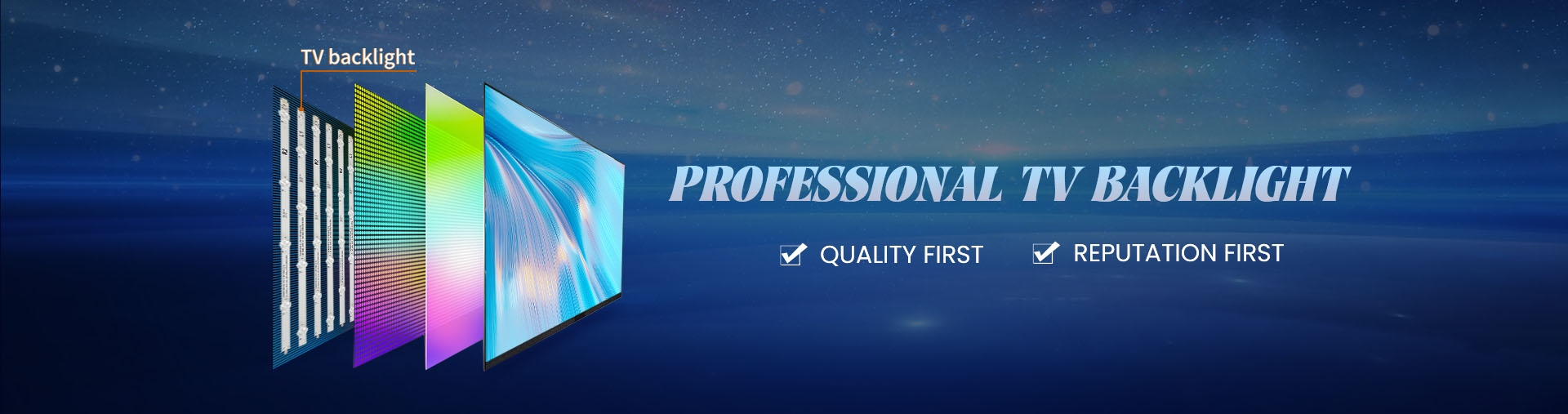
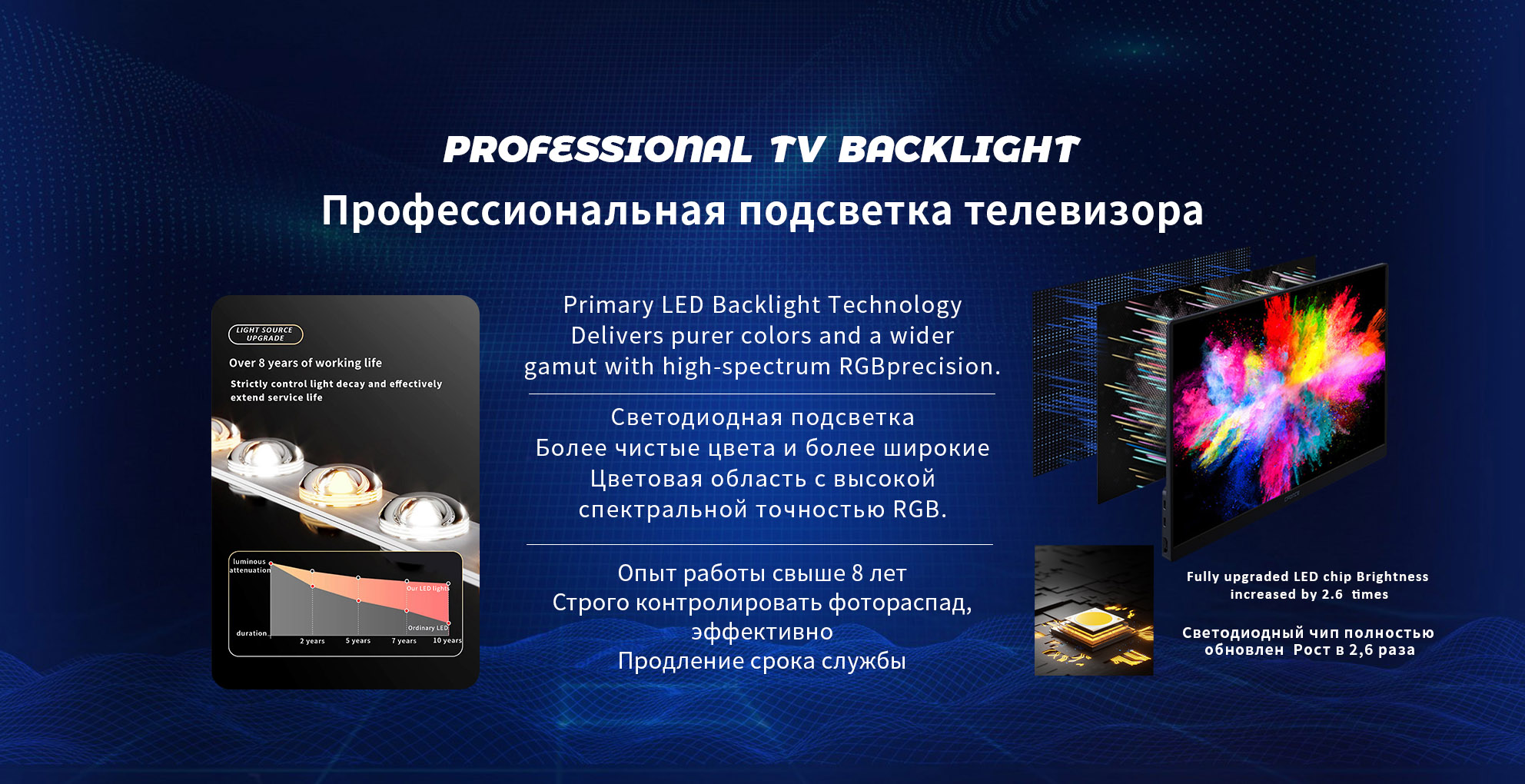
backlight strips matter more than many buyers expect, because in an LCD TV or commercial display the backlight is the light engine that the liquid crystal panel “shapes” into an image. If the backlight is uneven, unstable, or mismatched in color, the panel can only mask so much. The result can be visible issues such as cloudy corners, dirty-screen effect, washed blacks, color tinting, or brightness pumping in HDR scenes. Technical notes on LED backlighting highlight that backlight quality influences both brightness and color accuracy, and small spectral shifts can become noticeable across millions of pixels.
Internal tv backlight strips (replacement or OEM strips)
These sit inside the TV, behind the diffuser stack. They directly affect measured picture quality: luminance uniformity, black level behavior, and color consistency.
External bias-light strips (mounted behind the TV on the wall)
These do not change the TV’s native output, but can improve perceived contrast and viewing comfort in dark rooms when used correctly.
This article focuses primarily on internal tv backlight strips, which is Starsharp’s core product direction.
How internal backlight strips change what you see on screen
Uniformity and “clouding”
Uniformity is the most visible link between strips and picture quality. If LED spacing, lens geometry, reflector design, or assembly alignment varies, the diffuser cannot fully smooth the light field. That can show up as banding on 5%–10% gray scenes or blotches on mid-gray. Independent test methodologies commonly quantify uniformity by analyzing luminance variation across a gray field, which correlates strongly with real content issues like dark-scene patchiness.
Color tint and white-point drift
Even if brightness looks even, different LED bins or thermal drift can introduce a pink or yellow tint across zones. Because LCD color filters assume a stable backlight spectrum, backlight shifts can reduce color accuracy and make neutral grays look “dirty.”
Flicker and motion comfort
Low-quality drive design or incompatible replacement strips can introduce flicker or temporal instability. While some modulation is unavoidable in LED systems, a well-matched strip and driver pairing helps minimize visible artifacts and improves viewing comfort, especially at lower brightness settings.
HDR behavior and dimming artifacts
HDR TVs often coordinate the backlight with the image per refresh. If strip layout and electrical characteristics are inconsistent, local-dimming transitions can show pumping or halos. HDR system guidance emphasizes that backlight updates must be synchronized tightly with the image pipeline to avoid visible artifacts.
When backlight strips do not improve picture quality
If a display already has a stable, uniform backlight, swapping to a brighter strip alone will not automatically create a better image. You can raise peak luminance, but you may also raise black floor, reveal uniformity flaws, or push the diffuser stack beyond its design point. HDR content is often mastered for very high peak brightness, but real-world performance depends on the full optical and thermal system, not just LED output.
Quick checklist for evaluating strips before you buy
| What to evaluate | Why it matters to picture quality | What to ask for |
|---|
| LED bin consistency | Reduces tinting and patchy whites | Bin control approach, consistency targets |
| Optical design (lens/reflector) | Improves uniformity and reduces hotspots | Lens type, reflector/blue tape options |
| Electrical match (V/I) | Avoids instability, overheating, flicker | LED voltage, current rating, driver compatibility |
| Thermal path (aluminum PCB) | Limits color drift and early aging | PCB width/thickness, heat-spreading design |
| Model coverage and traceability | Lowers risk of mismatched replacement | Part mapping, labeling, QA records |
Starsharp product pages indicate process options such as reflector sheet and tape solutions to enhance reflection efficiency and structural stability, which are directly tied to brightness uniformity outcomes.
Where Starsharp fits as a backlight-strip manufacturer
For buyers who need stable supply and broad model coverage, Starsharp positions itself around TV direct-lit strips and edge-lit strips, plus commercial display-related backlighting. The site also states an annual production and sales capacity above 26 million units and a large catalog of specifications/models, which is useful when you manage multiple screen sizes and BOM variants across projects.
Practical guidance: what to do if you see picture issues
Patchy dark scenes or banding: prioritize optical uniformity design and tighter bin control, then confirm assembly alignment requirements.
Yellow/pink corners: review LED binning consistency and thermal management, and confirm whether the diffuser stack is aging.
HDR “pumping” or halos: verify electrical matching and backlight-driver coordination, especially if the product uses zone dimming.
Eye fatigue in dark rooms: consider adding external bias lighting with a high CRI and controlled brightness, since it changes perception more than the panel’s output.
Conclusion
Yes, internal backlight strips can materially affect picture quality because they set the foundation for brightness uniformity, color stability, and HDR backlight behavior. External bias-light strips mainly affect perceived contrast and comfort. If you treat backlight strips as a critical optical component rather than a simple spare part, you can reduce field complaints and keep display performance consistent across batches. Starsharp’s broad model coverage and production scale make it a practical option when you need reliable backlight-strip sourcing for TV and display projects.