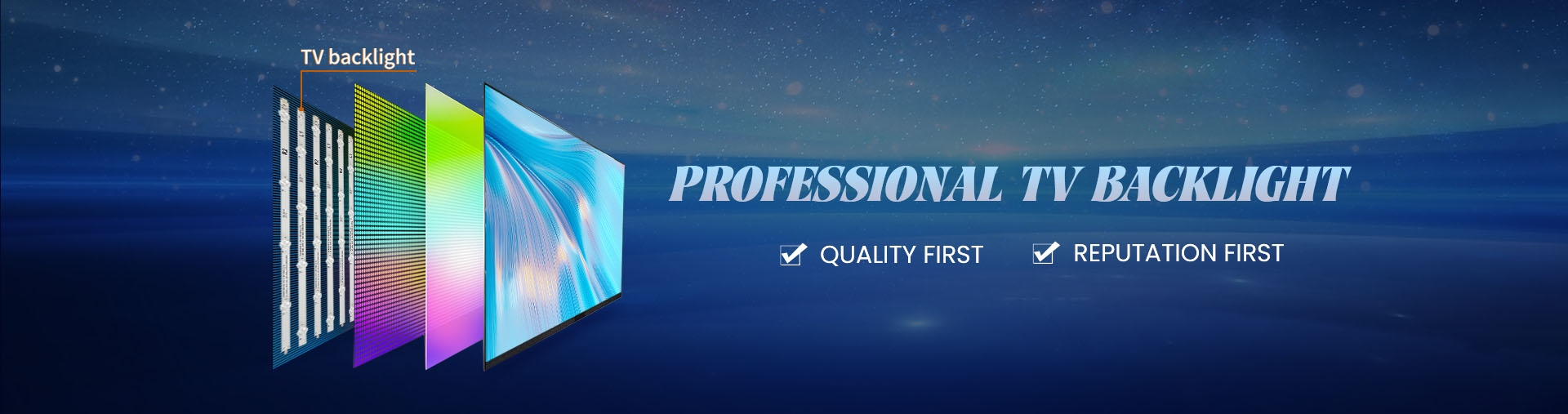
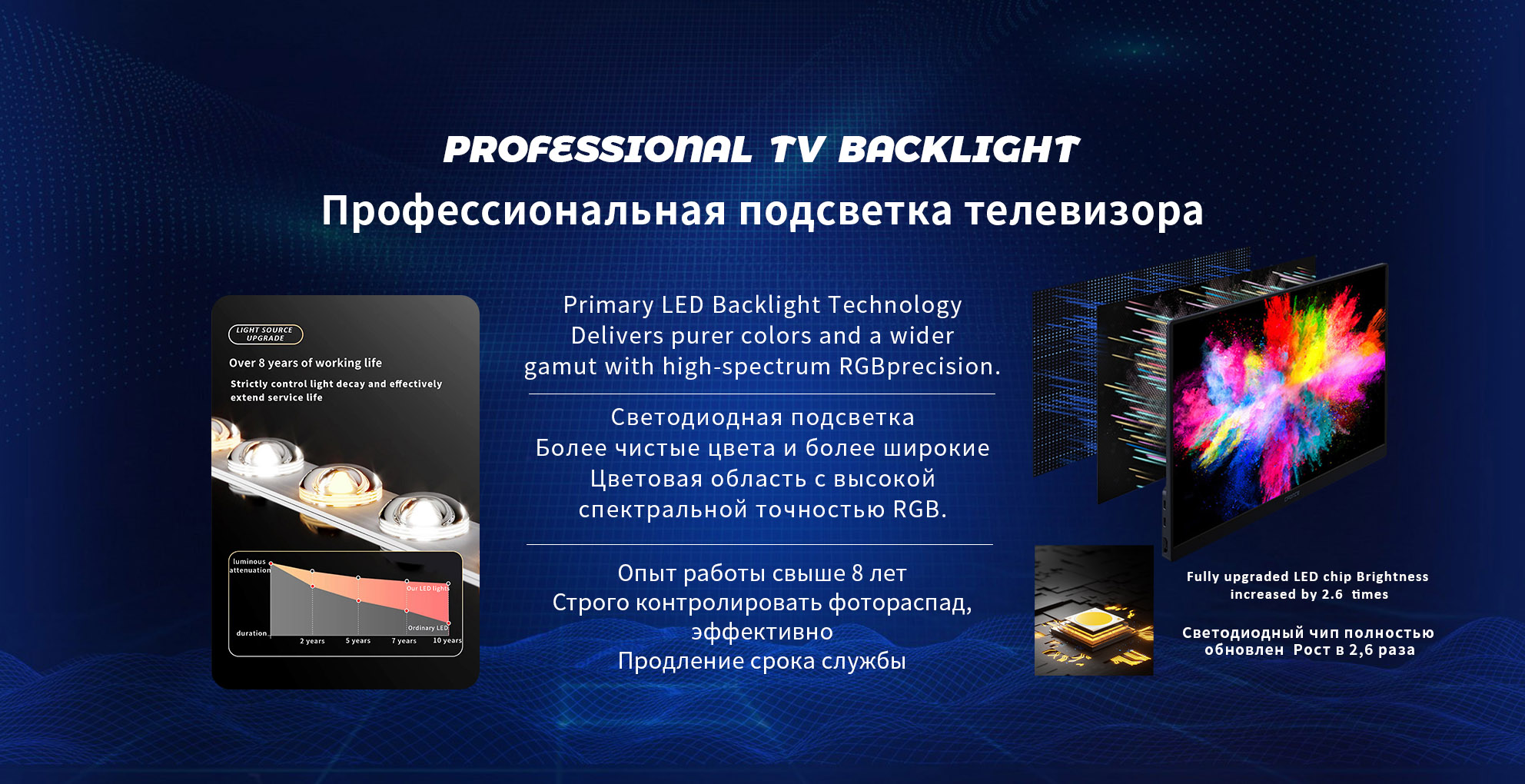
led tv backlight is the light source that makes an LCD television image visible. The LCD panel itself does not create light on its own. Instead, a backlight module sends controlled light through optical films, liquid crystal layers, and color filters so the screen can show brightness, contrast, and color. In practical manufacturing terms, the backlight system is one of the most important assemblies in a TV because it directly affects uniformity, energy use, thermal stability, and long-term reliability. Research on LCD technology confirms that liquid crystal materials do not emit light and therefore require a backlight unit, while modern LED TVs use LEDs in place of older CCFL systems.
The Basic Working Principle
At the core, the process is simple:
LED chips generate light behind or along the edge of the panel.
That light is shaped by optical materials such as a light guide plate, diffuser sheets, and reflective layers.
The LCD layer modulates the amount of light that passes through each pixel.
Color filters create red, green, and blue subpixels.
The final image appears on screen with the brightness and contrast set by the backlight system and the LCD drive.
This is why buyers in the TV repair, replacement parts, and display supply chain pay close attention to backlight strip design. Even if the LCD glass is intact, poor backlight consistency can cause dark areas, color temperature drift, flashing, or early failure. A stable backlight system is not just about illumination. It is about screen performance over time.
Why LED Backlight Replaced Older Systems
Earlier LCD TVs often used CCFL tubes. LED backlighting became mainstream because it improved energy efficiency, supported slimmer product structures, and helped raise contrast and color performance. Technical industry sources note that LEDs require lower voltage to reach luminance and offer longer service life than CCFL backlights, while also supporting better control of brightness across the panel.
For procurement teams, this matters in two ways. First, LED strips are easier to standardize across different TV models and sizes. Second, replacement demand remains strong because backlight strips are one of the most service-sensitive parts in the television structure.
Main Backlight Structures in LED TVs
Not all LED TV backlights work in exactly the same way. The operating principle is shared, but the LED arrangement changes the result.
| Backlight type | How it is arranged | Main strength | Main limitation |
|---|
| Edge-lit | LEDs are placed around the edge and guide light across the panel | Slim cabinet design and lower material use | More difficult to achieve deep uniform blacks |
| Direct-lit | LEDs are placed behind the panel in rows | Simpler full-surface illumination | Usually less precise contrast control than advanced arrays |
| Full-array with local dimming | LEDs are distributed behind the screen in zones | Better contrast and stronger highlight control | Higher system complexity and cost |
lg explains that direct-lit TVs use rows of LEDs behind the screen surface, while full-array systems add local dimming for deeper blacks and better picture depth. RTINGS also notes that local dimming improves contrast by dimming selected zones in darker image areas.
What Local Dimming Actually Does
A standard backlight can raise or lower brightness across the full panel. Local dimming divides the backlight into multiple zones, allowing darker zones to dim while brighter areas remain illuminated. This helps the screen display stronger contrast and more convincing shadow detail, especially in HDR scenes.
For component buyers, local dimming adds more than picture quality value. It also increases the performance requirements of the strip layout, thermal design, matching tolerance, and driver coordination. That means a supplier must do more than provide the correct length and connector. They need stable optical consistency, reliable soldering, and repeatable electrical performance batch after batch.
Key Parts Inside a TV Backlight Module
A complete LED TV backlight system usually includes several linked elements:
LED strips
These are the main light sources. Their brightness, wavelength consistency, forward voltage, and thermal behavior directly affect screen quality.
Lens system
Lenses help spread light from each LED so bright spots do not appear on the panel surface. Poor lens matching can create uneven light distribution.
Optical films
Diffusers and prism films help smooth the output and improve brightness efficiency across the display.
Reflective materials
These keep more light moving toward the LCD panel instead of being lost inside the structure.
Driver and electrical design
Current and voltage stability are essential. If the drive current is inconsistent, brightness drift and shortened service life can follow.
This is exactly why inspection standards matter. On its website, StarSharp highlights incoming checks for wavelength, color spectrum, color temperature, luminous flux, current, voltage, packaging materials, lens dimensions, and high-voltage resistance testing at 3000 to 5000 volts.
What B2B Buyers Usually Care About
For wholesalers, service companies, and display parts importers, the main question is not only how LED TV backlight works in theory. The practical question is how reliably it works after installation.
A dependable supplier should be able to support:
stable optical parameters across batches
clear matching of strip codes and TV models
controlled soldering and assembly precision
aging and high-voltage tests before shipment
fast response for replacement demand and repeat orders
StarSharp’s published company information shows capabilities that are highly relevant to these needs: more than 10 years in television backlight development and production, annual capacity above 26 million units, over 5,000 specifications and models, exports to more than 60 countries and regions, a 7,500 square meter workshop, 10 fully automatic production lines, daily output up to 100,000 strips, plus an optical laboratory and aging room for testing.
Why This Matters for Sourcing
When a buyer understands how LED TV backlight works, it becomes easier to judge supplier value. The backlight system is not a simple accessory. It is an optical and electrical assembly that determines whether the LCD panel can deliver a clear and stable image. Backlight type affects cabinet thickness, contrast behavior, and thermal performance. Strip quality affects maintenance cost, warranty exposure, and customer satisfaction.
For businesses serving the TV repair and display replacement market, working with a supplier that covers both direct-lit and edge-lit solutions, maintains broad model compatibility, and has in-house testing resources can reduce sourcing risk significantly. StarSharp positions itself strongly in this area through wide model coverage, automated production, optical inspection capability, and experience in global supply.
Conclusion
LED TV backlight works by generating controlled light behind an LCD panel, then shaping and modulating that light into a visible image. The better the backlight design, the better the screen can perform in brightness uniformity, contrast, and long-term stability. For buyers, that turns backlight strips from a basic spare part into a technical product category that deserves careful supplier evaluation.
For companies looking for consistent LED tv backlight strips, broad model coverage, and production support backed by testing and automation, StarSharp offers a strong manufacturing foundation for stable supply and long-term cooperation.