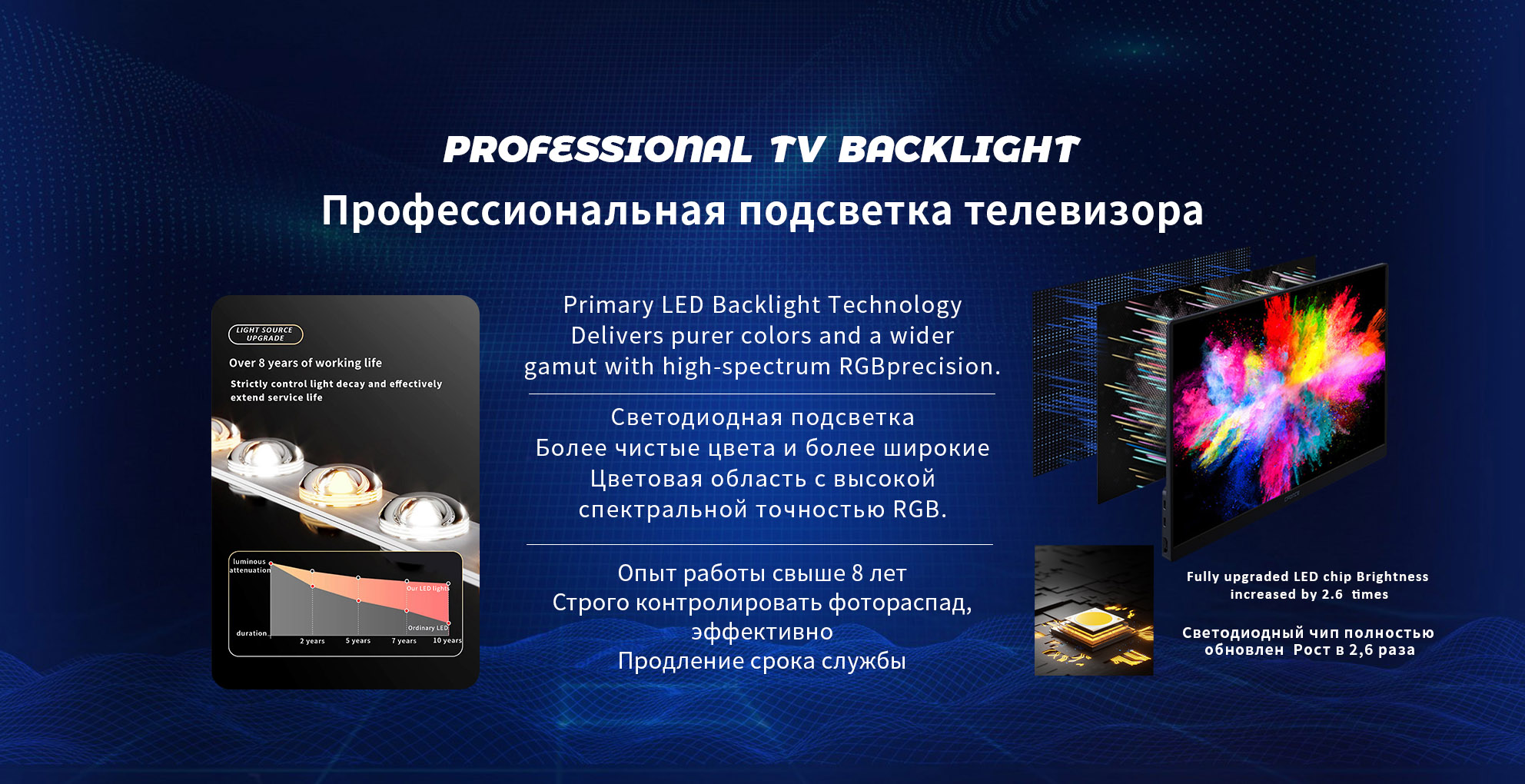
led tv backlight strips do not operate at one universal voltage. Individual LEDs may commonly use different forward-voltage designs, while the complete strip voltage depends on LED quantity and circuit arrangement. The television's backlight driver supplies the required operating conditions, so replacement strips must match the intended electrical specification rather than being selected solely by size or connector shape.
Why Can Backlight Strip Voltage Differ?
LEDs connected within a strip form an electrical circuit. Changing the number of LEDs, their characteristics or the series and parallel arrangement changes the voltage requirement of the assembly.
Two strips can therefore have the same physical length but require different operating conditions.
This is why tv backlight strip voltage should be treated as part of compatibility verification rather than a general value applying to all televisions.
What Do 3V and 6V LEDs Mean?
The terms 3V and 6V usually refer to the approximate forward-voltage category of individual LEDs used within a backlight design. They do not mean that an entire long strip operates from only 3V or 6V.
Multiple LEDs are arranged into circuits, and the driver operates according to the complete backlight design.
Substituting one LED specification for another without confirming the circuit is therefore inappropriate.
Which Electrical Details Should Buyers Check?
| Item | Why It Matters |
|---|
| LED voltage type | Determines individual LED behavior |
| Number of LEDs | Influences circuit requirement |
| Circuit arrangement | Affects total operating voltage |
| Connector polarity | Determines correct connection |
| Strip reference | Helps identify original specification |
| Driver compatibility | Supports correct system operation |
Electrical specifications should be reviewed together rather than independently.
Can Strips With Different Voltages Be Interchanged?
They should not be assumed interchangeable. A PCB that fits correctly can still have a different LED or circuit configuration.
Incorrect matching may prevent normal illumination, create abnormal brightness or place inappropriate electrical stress on the backlight system.
For replacement sourcing, using the original strip reference, PCB markings and verified specification is safer than estimating voltage from strip length.
How Can Buyers Confirm Voltage Before Ordering?
Start by recording the original strip code and complete television or panel information. Clear photographs can help distinguish revisions when multiple references exist.
Electrical testing should be performed with suitable LED testing equipment and appropriate technical knowledge. Measurements need to be interpreted according to the strip circuit rather than treated as the rating of a single LED.
When uncertain products are being sourced in quantity, sample confirmation can reduce the risk of multiplying a specification error across a bulk order.
Voltage Is Only One Part of Compatibility
Voltage matching cannot replace checks of PCB length, LED spacing, lenses, mounting holes and connectors. A correct replacement needs electrical and mechanical characteristics to work together.
An Led Backlight Strip supplier should therefore confirm the product from multiple specification points rather than matching a single voltage value. Maintaining verified references for repeat orders also makes future procurement faster and reduces the risk of mixing electrically different backlight strips within the same inventory.